Are You a Kuudere?
Kuudere literally means "cool dere" — the type whose love language is precision rather than warmth. Kuudere characters keep their emotions locked behind a calm, clinical exterior, not because they don't feel, but because feelings without strategy are dangerous in their world. If your friends say you "always know what to do" and rarely see you panic, the kuudere strategist might already be how you carry yourself. Take the 90-second Yumetype quiz to confirm.
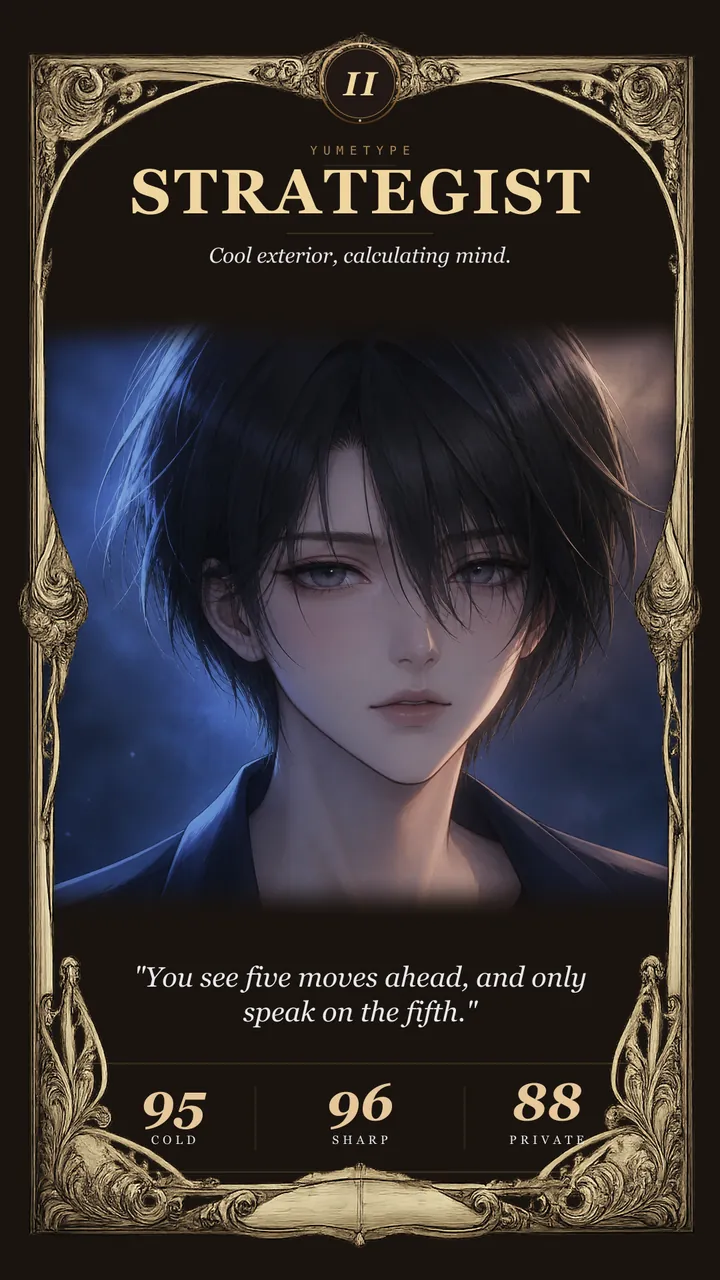
What is a kuudere?
A kuudere (クーデレ) is one of four classic dere-types in anime archetype taxonomy. The "kuu" comes from English "cool" and "dere" from "deredere" (lovestruck). Together: cold on the outside, warm on the inside — but unlike a tsundere, the kuudere doesn't lash out. They go quieter. The defining behavior is restraint with information: they know more than they say, and what they say has been calculated three steps ahead.
Kuudere core traits
Yumetype's 5-axis profile reads kuudere as low Energy, slightly low Warmth, low Cognition (analytic over instinctive), low Drive (inward-directed validation), low Intensity. The result on the card: 95 COLD · 96 SHARP · 88 PRIVATE. The kuudere isn't emotionless — they're emotionally aristocratic. Each feeling is cataloged, weighed, and stored. The few they let out are the ones they've decided to.
Kuudere vs dandere — telling them apart
Both are quiet, but the silences are different. The dandere is silent because connection scares them; once trust forms, they bloom. The kuudere is silent because speech is a tool to be deployed economically. A dandere watches the room and waits to be invited in. A kuudere watches the room and decides who's worth bringing in. Same surface, opposite engine.
Signs you might be a kuudere
You know more than you say, and what you say has been weighed three steps ahead. Friends call you unflappable — the one who always knows what to do and never panics. Your care shows in precision rather than warmth: not 'I love you' but 'you're late, eat this.' If your quiet feels like a door you choose when to open rather than a wall someone has to climb, that's kuudere — not shyness, strategy.
The kuudere shadow
The shadow of kuudere is loneliness as a competence trap. The strategist runs the world from a distance; the distance becomes the world. Yumetype's inner letter speaks specifically to this — the part of you that has been everyone's steady ground while standing on nothing.
Is kuudere the same as INTJ?
They rhyme but aren't identical. Many INTJs score kuudere because of high analytic + low outward expression. But INTPs, ISTJs, and even some INFJs can land here too. MBTI describes how you process; kuudere describes how the world reads your processing. Yumetype combines both views via the 12-axis vector + 5-axis projection.
FAQ
Is kuudere the same as INTJ?
Loosely. Many INTJs score kuudere on Yumetype, but kuudere is specifically the narrative archetype of cool-strategist, while INTJ is a cognitive-function profile. INTPs, ISTJs, and reserved INFJs can also land kuudere.
Are kuuderes shy?
No. Kuuderes are quiet by choice, not by anxiety. A shy person wants to talk but can't; a kuudere can talk but decides not to. If your silence comes from social fear rather than strategy, you're probably closer to dandere-bloomer.
Can a kuudere fall in love?
Yes — but the expression is precise, not effusive. A kuudere doesn't say "I love you," they say "you're late, eat this." The love is in the specificity, not the volume.
What's the difference between kuudere and yandere?
Kuuderes are cool and detached. Yanderes are obsessive and possessive. Yumetype intentionally does not include yandere as an archetype because the trope often overlaps with unhealthy attachment patterns; kuudere strategist is the closest "cold-but-loyal" reading.
How do I know if I'm kuudere or just introverted?
Take the 90-second quiz — Yumetype's 5-axis system separates introversion (low Energy) from kuudere (low Energy + low Warmth-expressed + analytic). Pure introverts often land on dandere, mage, or ronin instead.
RELATED ARCHETYPES
Yumetype · 90-second AI anime archetype quiz · 12 archetypes · The Kuudere Strategist