Are You a Shounen Protagonist?
The shounen protagonist is anime's loudest archetype — the one who throws themselves at the impossible because someone has to, and the math comes later. If you've ever volunteered for the hard thing before knowing the cost, if you trust people who haven't earned it yet, if your conviction outruns your plans — you might already know the answer. Take the 90-second Yumetype quiz to find out where on the 12-archetype spectrum your soul actually lands.
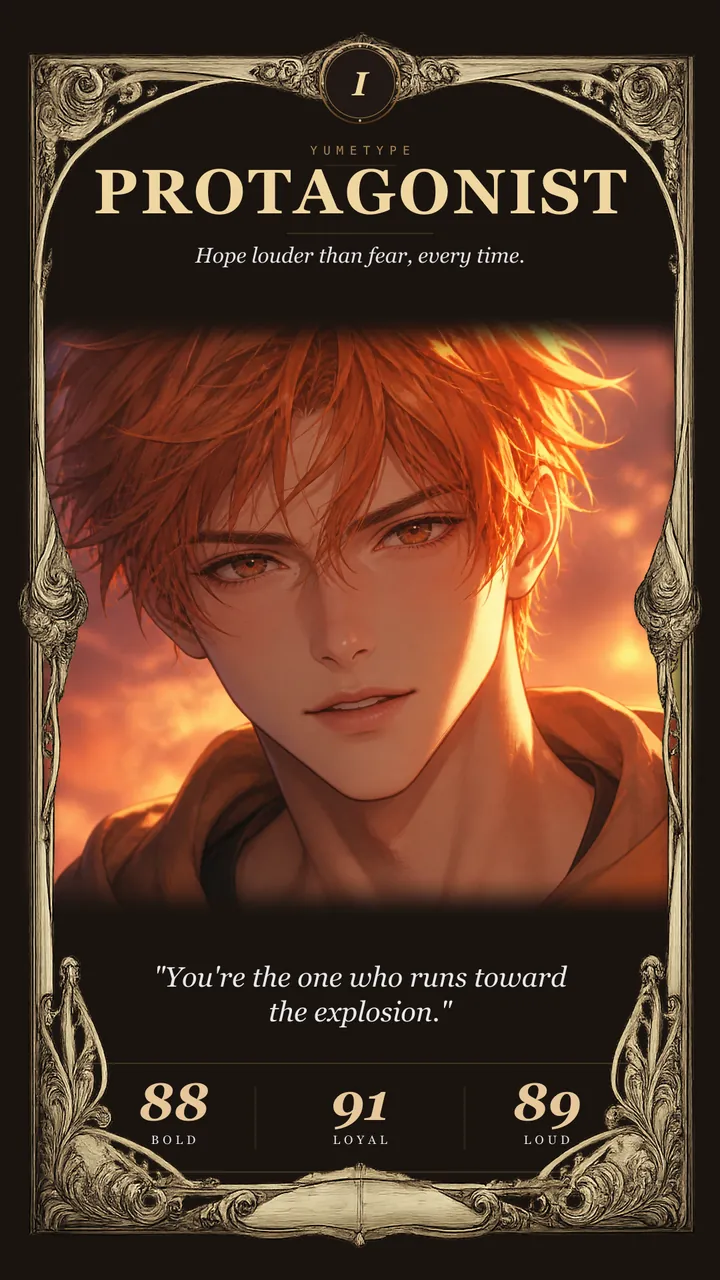
What is a Shounen Protagonist?
A shounen protagonist is the main-character archetype in Japanese coming-of-age anime — typically young, idealistic, and powered by belief over preparation. They lose, get up, and run again before their heart catches up. The signature isn't physical strength; it's the refusal to harden under pressure. People follow them because they choose softness as a weapon, not despite it.
Core traits
Five traits define the shounen protagonist on Yumetype's map: high outward energy, instinctive over analytic, drive directed at external goals, high emotional intensity, warmth that includes both allies and enemies. They feel things at full volume. They'll outrun their own plans. They'll lose, get up, and run again before their heart catches up.
How shounen differs from rival
Both shounen and rival are high-energy outward archetypes, but the shounen protagonist is conviction-driven while the rival is opposition-driven. A shounen runs toward a goal regardless of who else is in the race. A rival sharpens against a specific other person — without that mirror, their drive can stall. If your competitive fire only kicks in when someone else is in the room, you might be rival-coded rather than shounen.
The shounen shadow
The hidden cost of shounen energy is exhaustion. Conviction is renewable, but it isn't infinite. The protagonist who never stops running can become the protagonist who never lets themselves grieve. Yumetype's deeper read accounts for this — your inner letter speaks to the part of you that's been carrying everyone, and asks whether anyone's been carrying you back.
Is shounen the same as MBTI ENFP?
No. The shounen protagonist isn't a Big Five or MBTI mapping — it's a narrative role. ENFPs and ENFJs often score shounen because of high E + warmth, but Yumetype's 5-axis system also weighs Drive direction and Intensity register. A quieter ENFP might land closer to genki-spark or kemonomimi-healer instead.
Signs you might be a shounen protagonist
You volunteer for the hard thing before knowing the cost. You trust people who haven't earned it yet. Your conviction outruns your plans — you lose, get up, and run again before your heart catches up. Friends describe you as 'a lot' in the best way, and rallying people feels more natural than planning for them. If that reads like a report card, the shounen protagonist is likely your soul shape — the quiz confirms in 90 seconds.
FAQ
Is the shounen protagonist always male?
No. The archetype is about narrative function (charge-toward energy + idealistic conviction), not gender. Yumetype renders this archetype in feminine, masculine, and androgynous portraits — pick whichever matches your inner image.
How rare is the shounen protagonist?
It's one of the more common results because the trait pattern (high energy, outward drive, idealism) is widely shared. Yumetype's rarity tier system frames this as "CORE" — the human-pattern bedrock, not a lesser result. You're in good company.
Can I be a shounen protagonist and a kuudere at the same time?
No, you're primarily one. But Yumetype shows a "shadow archetype" when your second-place is close to your primary — so a shounen with a strong kuudere shadow reads as someone whose conviction is real but who needs space to plan it.
Is shounen the same as INFP or ENFJ in MBTI?
They overlap loosely but aren't identical. MBTI maps cognitive function preferences; shounen is a narrative role. Many ENFJs score shounen, but high-energy ESFPs and idealistic INFPs do too. The 12-archetype system is finer-grained than MBTI for narrative identification.
What's the opposite of shounen protagonist?
On Yumetype, shounen-protagonist's opposite is kuudere-strategist — outward + emotional vs. inward + restrained. Together they form a complete narrative: the one who charges and the one who plans the charge.
RELATED ARCHETYPES
Yumetype · 90-second AI anime archetype quiz · 12 archetypes · The Shounen Protagonist